
Montgomery County City Directory Collections
Montgomery County has no single continuous city-directory run. The useful shelf is regional and town-specific. The Silver Spring Historical Society guide, hosted by Montgomery History, points to Nelson and Polk volumes for Washington suburbs, later Silver Spring books, and community phone books. Peerless Rockville holds Rockville volumes and related directory material. These records earn their keep because an alphabetical listing and a street-order listing answer different questions about the same household. Always confirm the stated holder and access channel for the particular volume you need. Not every year sits online.
| Collection | Years | Where Held | Access |
|---|---|---|---|
| Nelson’s Washington Suburban Directory | 1912, 1916-1918, 1923 | Silver Spring Historical Society local collections | Appointment; paper volume and related local material |
| Polk’s Washington Suburban Directory | 1927-1928, 1930-1931 | Silver Spring Historical Society and Maryland historical references | Appointment; listed copies are 25 cents per page |
| Polk’s Silver Spring City Directory | 1954, 1960, 1962, 1964, 1966, 1968-1969, 1971, 1973 | Silver Spring Historical Society | Appointment; town-specific printed runs |
| Rockville directory material | 1918; 1958-1959, 1961, 1968-1976 | Peerless Rockville, Historic Red Brick Courthouse | Finding aid and staff contact |
| Silver Spring Community Phone Books | 1995-present | Silver Spring Historical Society | Appointment; later address and phone snapshots |
The published runs also show real gaps. One cited Silver Spring house-history source records a jump from 1931 to 1960. Missing decades call for digging, not assumptions about who stayed put.
Montgomery County Directory Years
Nelson's suburban volume opens the printed sequence in 1912. Nelson returned for 1916 through 1918 and again in 1923. Polk's suburban books follow in 1927-1928 and 1930-1931. Selected Silver Spring Polk years span 1954 through 1973. Rockville's Polk run covers 1958, 1959, 1961, and 1968 through 1976. A 1979 Rotary roster in the Peerless Rockville finding aid serves as a supplementary name source, though it is not equivalent to a city directory.
- 1912: Nelson’s Washington Suburban Directory appears in the documented Montgomery-area holdings.
- 1927-1931: Polk’s Washington Suburban volumes provide a bridge across the late 1920s and early 1930s.
- 1954-1973: Selected Polk Silver Spring volumes resume the local printed trail.
- 1958-1976: Rockville Polk volumes preserve several city years, with a separate 1918 Nelson entry.
Check the title page first. Adjacent holdings are not always one series. Peerless Rockville lists Nelson's Washington Directory and Nelson's Washington Suburban Directory as separate catalog entries, and that distinction changes which places, names, and street guides a volume contains.
Montgomery County Library Records
The Jane Sween Research Library collections add the records that make a directory entry useful. The non-circulating holdings include family papers, Bibles, wills, deeds, correspondence, school yearbooks, business ledgers, maps, photographs, and vertical files organized by towns, communities, historic houses, organizations, and religious institutions. The library is at 111 West Montgomery Avenue in Rockville and lists 301-340-2825 for its research service.
Its Past Perfect Online catalog makes more than 1,100 described archive collections and items searchable and provides access to described photographs and objects. More than 14,000 photographs have been digitized. Tombstone inscription cards from 111 cemeteries and interment books can also clarify a surname after it disappears from a Montgomery County city directory.
The Peerless Rockville finding aid is a separate channel for Rockville streets, neighborhoods, transportation, directories, and town-center material. It can identify a relevant box or directory run before a visit or inquiry.
Peerless Rockville’s finding aid documents the local directory and neighborhood materials represented in this Montgomery County city directory research.
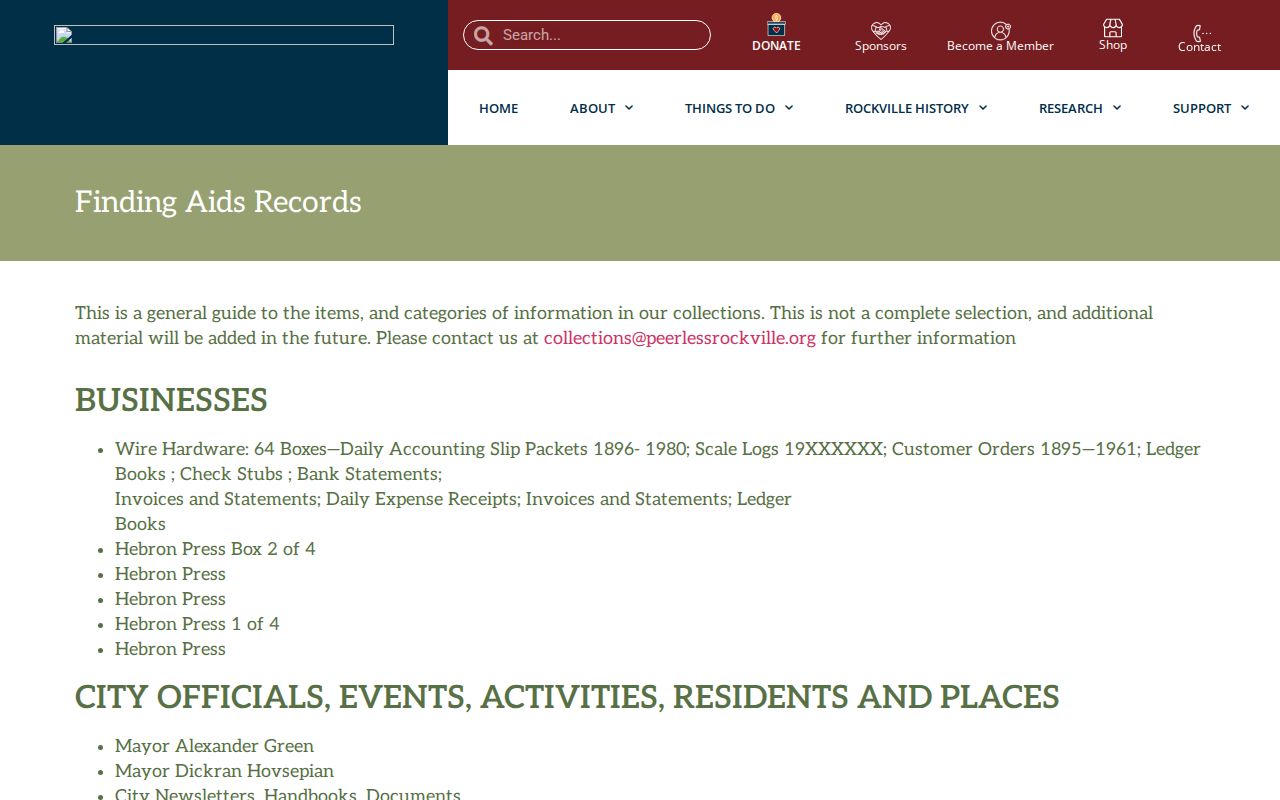
The finding aid distinguishes Rockville directory holdings from broader Washington suburban volumes before you request material.
Reading Montgomery County City Directory Entries
Historical directories usually run in two layers. The alphabetical section gives a name, occupation, business connection, residence address, and a family or household notation. The address section reverses the search. Often labeled a householder and street guide, it moves from address back to name. Every Montgomery volume needs its own symbol key checked. A contemporaneous Maryland entry explains why: "res." marks a residence, while a parenthetical business link or a same-address mark can shift how the entry should be read.
| Name | Surname, given name, initials, and sometimes a family or widow notation. |
|---|---|
| Occupation | A trade or professional role that can separate people with the same name. |
| Business connection | A firm name, partnership note, or same-as-business notation where printed. |
| Residence | House number and street, commonly marked with “res.” in the Maryland-era example. |
| Street-guide symbols | Owner, telephone, or household symbols only when the specific volume explains them. |
- Criss-cross directory
- A street-order section that starts with an address and names the listed household or subscriber.
- Householder index
- An address-oriented listing that helps connect a residence to the person recorded there.
- Abbreviation key
- The volume’s own list of short forms and symbols. Photograph or transcribe it before interpreting an entry.
Montgomery County Sentinel Trails
The Montgomery County Sentinel bridges the years when a city directory is absent. The run spans 1855 through 2020. Issues from 1855 through 1963 are digitized through Chronicling America and Maryland Digital Newspapers. Reading-room computers cover 1964 through 1969. The 1970 through 2020 issues sit on microfilm at Rockville Memorial Library. Montgomery History also holds genealogy abstracts for 1855 through 1934. Its general abstracts cover 1855 through 1916. Obituary clippings round out the collection.
An obituary can name a spouse, children, residence, church, funeral home, or estate clue. It should lead to probate or vital records. It cannot replace them. The Montgomery County Gazette, listed for 1960 through 2015, is another newspaper worth checking when the Sentinel runs thin.
Montgomery County Address Context
A printed address in a city directory tells you more once you set it against Montgomery County's older property records. Montgomery History keeps selected Sanborn fire-insurance sheets. The run spans 1892 through 1960, with updates to 1963 in some places, and covers Chevy Chase, parts of Bethesda, Silver Spring, and Takoma Park. Library of Congress scans add Rockville for 1915 plus selected Rockville and Gaithersburg sheets. Sanborn symbols mark a building's footprint, stories, construction, and use. They date the physical setting, not the title. Ownership clues come from the Klinge real-estate atlases of 1931 through 1959, which list owners, liber and folio references, building footprints, and subdivision growth. Two more layers help. The 1916 Deets & Maddox atlas offers one comparison. Later Lusk property material offers another. Each one lets you test whether an address in a residents directory matches the record of its era. A legal description, a lot and block, or a former road name often survives better than a modern street number. Montgomery History's collections overview describes the archival setting for these address-context records.
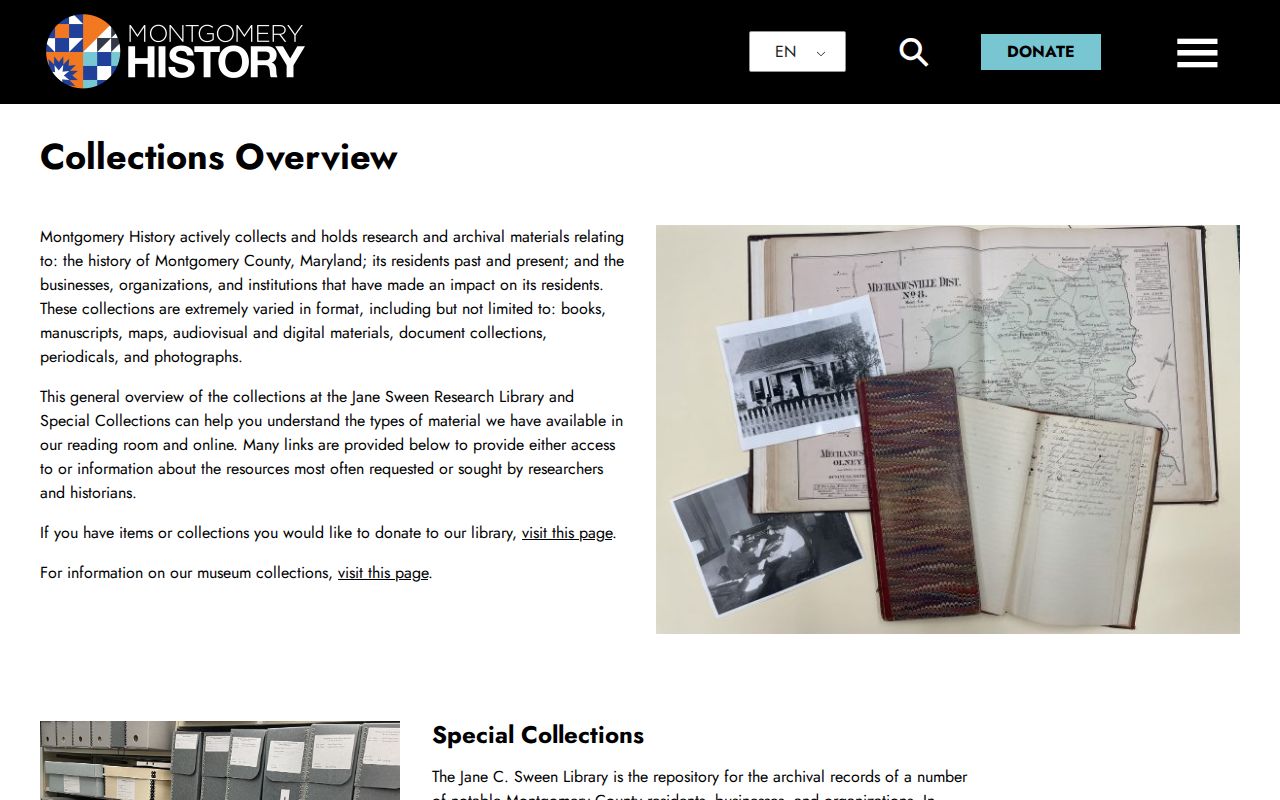
Printed collection records and the archival tools around them let you weigh an old address against the legal and physical facts of its community. That comparison is the real work.
Tracing Montgomery County City Directories
Start with the clearest address in the reverse or street guide section, and copy the name exactly as printed. Keep the suffixes. Keep the occupation and household marks too. Then move to the alphabetical section to check for a business tie and a residence line before repeating the search in the nearest year. Pair every directory date with the closest federal census. Census records open to the public run 1790 through 1950 under the 72-year release rule, and Montgomery History holds census copies plus early tax records for the county.
- Locate the household in an address-oriented section when the residence is known.
- Copy spelling, initials, occupation, address, and every printed symbol before searching another source.
- Check the alphabetical listing in that volume for a second description of the person.
- Repeat in the nearest prior and later directory years, recording changes rather than assuming a continuous stay.
- Compare the period with census, Montgomery land records, and Sentinel notices to test a move, death, or omission.
A name that drops out of a directory may reflect a move, a death, an unlisted household, or a changed street convention. The surname alone cannot settle it. When an old address needs modern parcel context, the Montgomery County street directory picks up the address-keyed records of today. It leaves the historical shelf behind.
Montgomery County Directory Gaps
A property card, a postal address, and a directory listing each record a different relationship to a place. None proves physical presence. A directory is an annual editorial snapshot. It can keep a former resident after a move, omit children, repeat a deceased person, or follow an address convention unlike the current one. Comparison across independent records answers doubt.
For early family history in Montgomery County, the printed runs are only a start. Montgomery History abstracts wills from 1776 to 1875. It also abstracts marriages from 1798 to 1898, land records from 1777 to 1865, tax assessments from 1793 to 1865, and census copies from 1776 to 1900. The Lincoln Park History Project and the Sween Library hold community, church, school, and oral-history material. Such collections keep continuity a directory alone can miss. They tie a surname to family property, civic institutions, and community history across years when the printed volumes stay silent.
For a first pass at these companion holdings, Past Perfect Online is a useful catalog search. It indexes the collection-level records. Start there when the shelf runs dry.
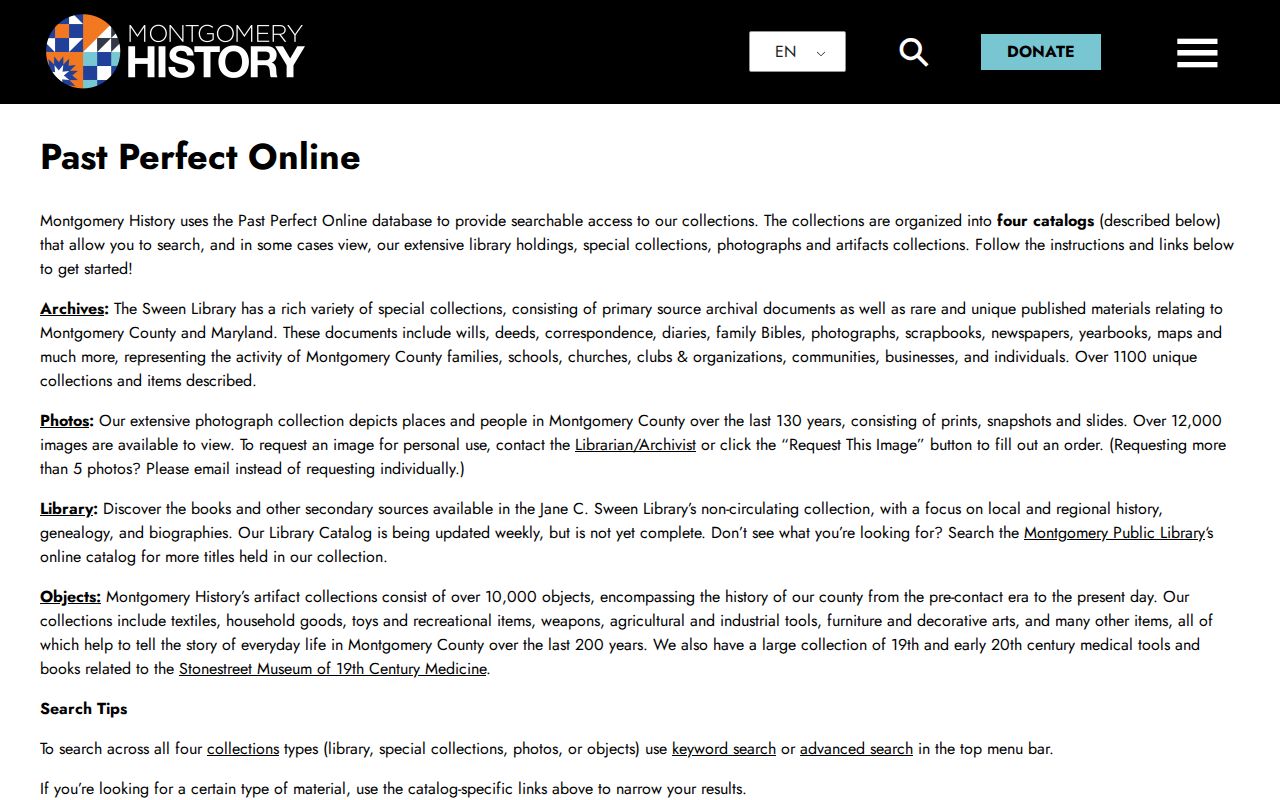
The catalog image shows the collection-level search route for pairing city directories with photographs, family papers, and other local-history descriptions. It is one screen, not a record itself.