
Montgomery County Previous Residents Sources
Think of the address trail as an era-by-era chain. Land records name the recorded parties and the legal description of the property. Historical directories and telephone books can place a listed household at a specific address. Census records and newspapers add the family layer a deed never captures. Every source has its own coverage pattern. Coverage gaps differ too. Access routes vary as well. Match the record to the date rather than forcing one type to answer every question.
| Source | Years It Covers | Where Held | What It Shows |
|---|---|---|---|
| MDLandRec and historical deed indexes | Land records from July 1777; original grantor/grantee series 1777-1976 | Circuit Court Land Records, MDLandRec, and Maryland State Archives | Recorded parties, deed type, liber/folio, legal description, and images |
| Montgomery directory runs | 1912-1976, with selected gaps; phone books 1995-present | Silver Spring Historical Society and Peerless Rockville | Listed households, addresses, occupations, and street-order entries where included |
| Federal census and local copies | 1790-1950 public records | National Archives sources and Montgomery History | Household and family context for the census period |
| Montgomery County Sentinel | 1855-2020 | Digitized sources, reading-room computers, and Rockville Memorial microfilm | Notices, obituaries, moves, building activity, and estate clues |
| Sanborn sheets and property atlases | Selected places 1892-1960; Klinge atlases 1931-1959 | Montgomery History and Library of Congress | Building context, street setting, subdivision development, and some owner references |
Match the tool to the era. A recent transfer starts with the present parcel record, then walks the deed chain backward. A gap between deeds calls for an address directory or a newspaper. For an early tract, turn to the Archives and the Sween Library's abstracts, since a current street number may not have existed at all.
Montgomery County Previous Residents Parcel Start
Begin with the parcel, not an owner-name search. The Maryland SDAT Real Property Search accepts Montgomery County plus a street address, street name, account identifier, or map reference. It rejects owner name, ZIP, town, neighborhood, subdivision, and community as search keys. Enter the situs address without direction or suffix abbreviations. A trailing asterisk broadens a street name. Omitting the number can help when an exact address fails. Once the card opens, record the owner, mailing address, situs address, PAN or account number, and map reference. The situs is the physical parcel. The mailing address is simply where SDAT sends correspondence, so it can differ from the parcel and proves nothing about physical presence. Montgomery County PAN numbers start with county code 16. The card also displays assessment, sales, property class, value, and tax-credit indicators. Treat those as context, not a full household record.
Montgomery County Previous Residents Deed Chain
The recorded ownership chain runs backward through the MDLandRec index and the Montgomery County Circuit Court Land Records Department. Land records date from July 1777. The historical grantor and grantee index series reach from 1777 through 1976. Retired material and equity indexes still matter, and they sit at the Maryland State Archives. Match the legal description or parcel details on each deed. A shared street number alone can stitch together the wrong property after subdivision changes or an address revision.
- Use the SDAT parcel card to copy the present owner, PAN or account number, and legal property clues.
- Search the current owner as a grantee or indexed party in MDLandRec and locate the most recent deed.
- Record its liber and folio, document type, date, legal description, and the seller named as grantor.
- Search that seller as an earlier grantee, then read the prior purchase deed.
- Repeat backward, checking the same tract, lot, block, condominium unit, or metes-and-bounds language at each transfer.
- When an online index is insufficient, move to courthouse computers, the Maryland State Archives’ retired and equity indexes, or microfilm material.
- Grantor
- The person or entity transferring an interest in a deed, often the seller or giver.
- Grantee
- The person or entity receiving the interest recorded by the deed.
- Chain of title
- The linked sequence of recorded transfers for the same property, read from one deed to the prior one.
- Legal description
- The deed’s formal land description, such as a lot and block or metes and bounds, used to identify the property beyond a street number.
Montgomery County Previous Residents Index Access
MDLandRec is free once you register with an email address. The county says a password normally arrives within about an hour on a business day. Searches run by name, liber and folio, or tax-account number. Scanned images link to the index after verification. For in-person work, Montgomery's land-record public-information room offers viewing and copying computers. It sits at 50 Maryland Avenue, North Tower, Room 2120 in Rockville. The room is open Monday through Friday, 8:30 a.m. to 4:30 p.m.
Copies carry modest fees. Regular documents cost 50 cents per page. Certified copies add $5 plus 50 cents per page. Triple seals add $10 plus 50 cents per page. Bring cash or a check, since credit cards are not accepted. These routes matter whenever an image is unavailable or an official copy is needed.
MDLandRec provides the login and document-index route used for the Montgomery County deed chain.
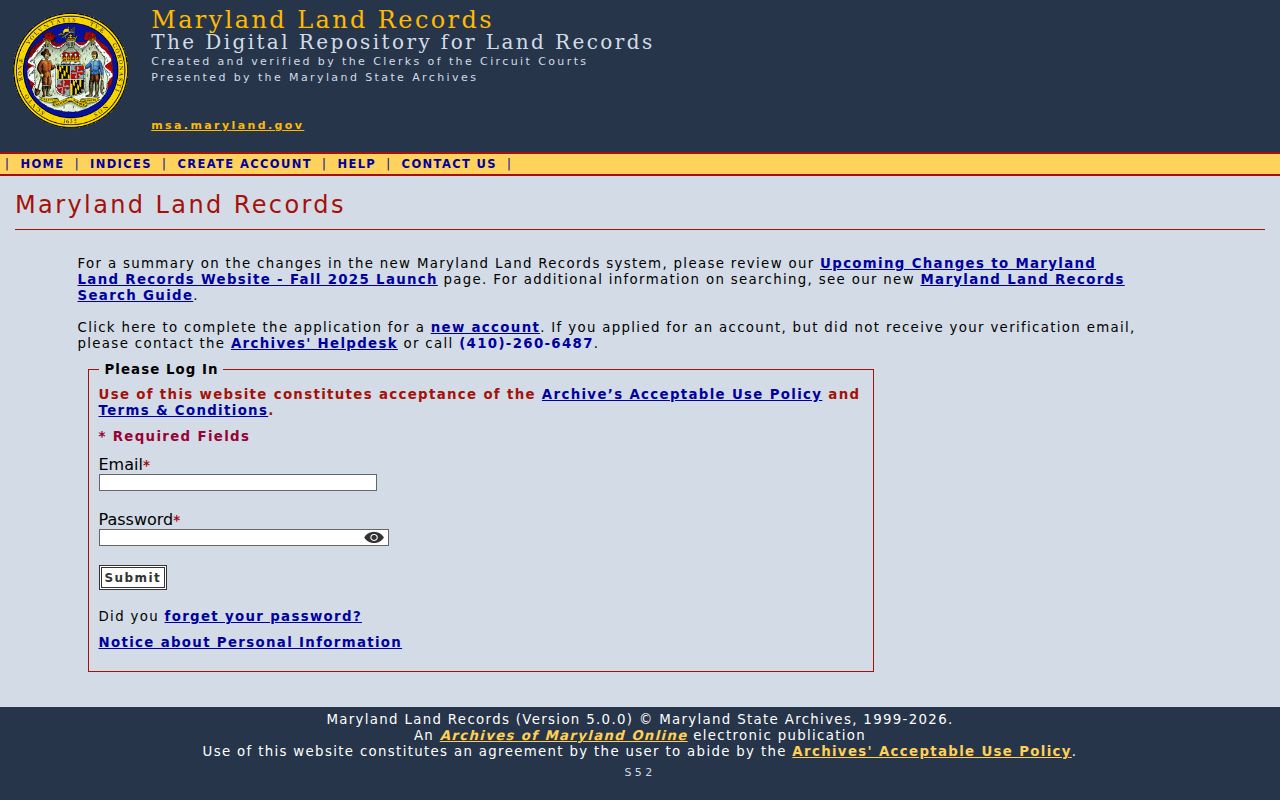
The deed-index view is the handoff. It carries a parcel identification over to the recorded parties and book-page references needed for earlier transfers.
Montgomery County Past Residents Address Myth
A familiar street number is not always the same historic place. Rockville's late-1960s urban renewal reoriented the Commerce Lane and Court Street area. Most surrounding buildings came down. An older directory entry may match a vanished block. It may also match an altered street relationship. County records can also lean on an old road, rural route, subdivision name, patent, lot, or metes-and-bounds description. They may do so instead of using a current number.
Myth. A modern address match does not prove a historic household occupied the same physical place. Confirm continuity through the deed description, street guide, historical sheets, plats, or atlas reference.
Plats.net holds subdivision, condominium, and survey plats. However, the land-record office keeps no individual house location plats. Montgomery History's 1916 Deets & Maddox material, its 1931-1959 Klinge atlases, and a patent overlay can tie an older description to a later parcel. Original grants through 1800 may carry names like "Bite the Biter," "Magruder's Folly," or "Chiswell's Inheritance."
Montgomery County Past Households
A deed names the people who held title. It does not name everyone who actually lived in the house. To trace past residents of Montgomery County, start with the street or address section of a directory. Then cross-check the alphabetical listing and the closest federal census you can reach. The directory holdings here span decades of suburban growth. Nelson's suburban volumes cover 1912, 1916 through 1918, and 1923. Polk's Washington Suburban books pick up the story for 1927 through 1928. They also cover 1930 through 1931. Selected Silver Spring Polk years run from 1954 through 1973. Rockville material reaches to 1976. The Montgomery County city directories page describes each collection in detail.
The workflow itself is straightforward, though the dates demand care. Move from the street guide to the exact name. Then go to the alphabetical entry. Next comes the nearest census year. Finish with newspaper and land checks. Remember that a directory is an annual snapshot. It can keep a name after a move. It may skip children entirely. It can also follow a street convention unlike the deed's. Two directory entries years apart never prove an unbroken stay.
- Find the address in the reverse or street-order section when an appropriate directory survives.
- Copy the name, initials, occupation, residence notation, and any volume-specific symbol.
- Find the alphabetical entry for a business connection or second residence clue.
- Pair the date with the closest public census and compare the household details.
- Use deeds, Sentinel notices, obituary material, and probate records to test moves, deaths, and estate transfers.
Montgomery County Past Residents House History
The Montgomery History property-research material gathers deeds, patents, directories, photographs, and atlases under one roof. Its Jane Sween Research Library holds non-circulating family papers, wills, deeds, and correspondence. It also keeps school yearbooks, maps, oral histories, and vertical files for communities and historic houses. Selected Sanborn sheets covering 1892 through 1960 sit alongside Klinge atlases from 1931 through 1959. These sources build context for a structure or a neighborhood's growth. Not every one names a resident, though.
Montgomery History also abstracts early wills, marriages, land records, tax assessments, and census material. The Maryland State Archives deepens the trail with early county records. These include land books, a 1778 census, and tax assessments starting in 1793. For addresses predating any directory, that chain of local and state repositories follows the online deed index. Montgomery History's property-research guidance opens the door to these local sources.
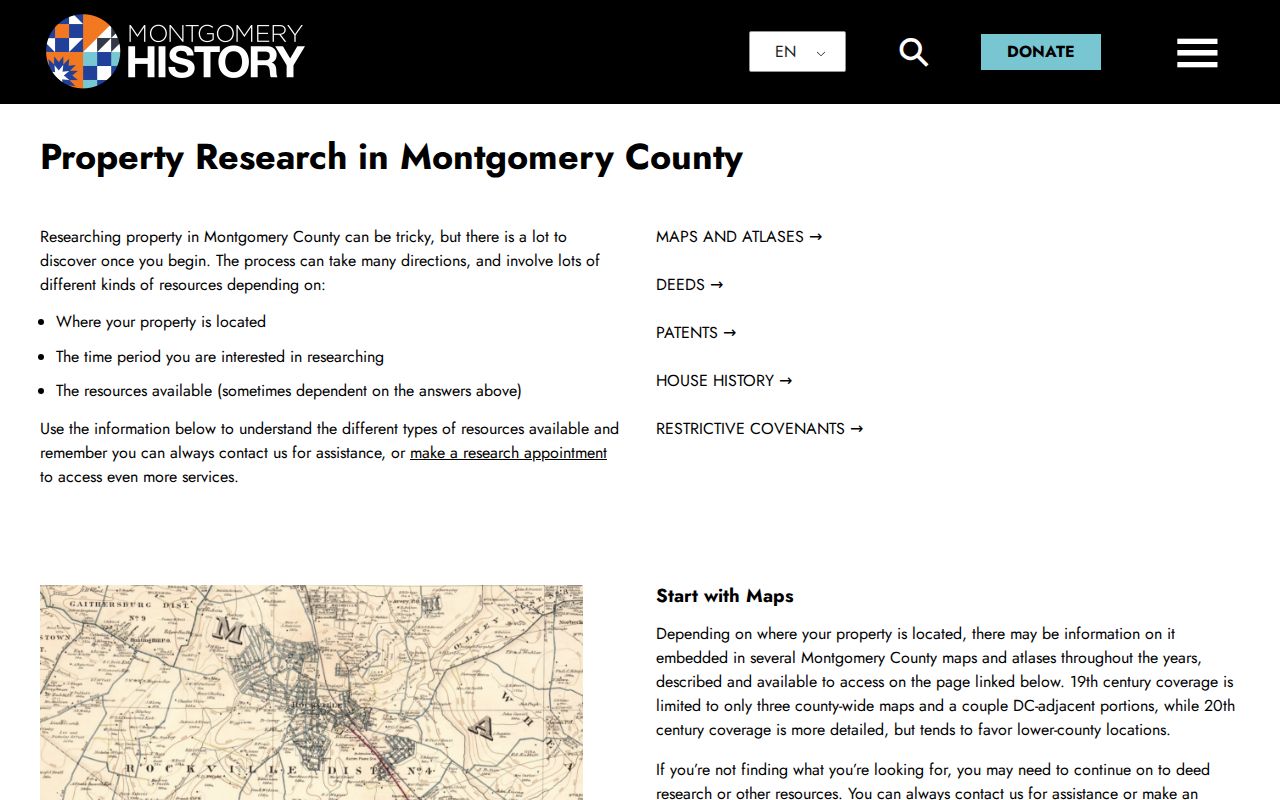
This resource offers a local starting point. It lets you weigh deed evidence against directories, photographs, and historical property references in one place.
Montgomery County Previous Residents Limits
House history serves family history, estate questions, preservation, and simple curiosity. But it has firm limits. A deed can record a transfer while saying nothing about who occupied the home. A directory may be incomplete. Sanborn sheets date a structure and show its form, yet they say nothing about title. Newspaper notices and obituaries point toward relatives and estates. But always verify them against primary records. Combine your sources, and record the date and access path behind each conclusion.
Some records sit with an agency but never appear online. The Maryland Public Information Act lets you request an existing nonconfidential record from its custodian. The law does not force an agency to build a new list or answer a research question for you. The strongest request names the parcel, the document, the date range, and the record type already surfaced by the trail.