
Montgomery County Resident Lookup Records
One record rarely settles a question of identity. The property roll names an assessed owner for a parcel. A deed shows who transferred what, plus the legal description. Court summaries from Maryland Judiciary Case Search are not complete files. Voter Lookup retrieves one matching voter's registration and polling details. It does not return every resident at an address. So frame the question first. Then let a second official Montgomery County record confirm what the first one suggested.
| Record | What It Confirms | Where | Access |
|---|---|---|---|
| Property roll | Assessed owner, parcel, tax mailing address, and sales or value context | Maryland SDAT Real Property Search | Free address, PAN, or map-reference search; no owner-name mode |
| Recorded deed | Buyer or seller, transfer, liber/folio, and legal description | MDLandRec and Circuit Court | Free login and images; certified copies use the clerk route |
| Court case | Party, caption, case number, dates, type, and status | Maryland Judiciary Case Search | Online summary; full file through the clerk |
| Voter record | Registration, district, polling, and ballot-status information for a matching voter | Maryland State Board of Elections Voter Lookup | Name, date of birth, ZIP, and street number required |
| Vital or estate record | Open event facts, decedent, representative, heirs, or proceeding dates | DVR, Maryland State Archives, or Register of Wills | Eligibility rules, archival access, and office requests vary |
Match the tool to the question. A current Montgomery County address is best checked against the assessor record, since it is keyed to the parcel. Estate research runs differently. Use the decedent's name in estate mode. Older family facts may call for Archives indexes, Montgomery History abstracts, a reading-room visit, or a written request rather than a general web search.
Verify a Montgomery County Resident
Follow a consistent trail of details. A situs address is the physical parcel. A mailing address is where tax notices go. Those two fields can differ on the same record. Middle initials, suffixes, dates, a spouse, a parcel number, a town, and the legal description all help separate same-name results without treating any single match as final.
- Normalize the name as it appears in a document, then note known variants, a middle initial, suffix, and any known Montgomery County address.
- Search SDAT by address, PAN, or map reference and record the assessed owner, mailing address, situs address, account, and map reference separately.
- Use the party search in Case Search for the exact name, then a careful surname wildcard if needed. Narrow a large result by court, county, case type, or filing-date range.
- Compare the case county, city or state, dates, caption, and party role with the parcel trail. Use Voter Lookup only when the full identity combination is lawfully available.
- When the match matters, request the source document from its custodian. A deed image, probate file, certified court copy, or eligible vital-record request carries more weight than an index line.
County offices can explain how to locate a file. They will not read protected details over the phone. An inaccurate court entry is fixed through the court that created or filed it. Keep the record number and viewing date. A written correction request gives the custodian a clear basis for reviewing the source record.
Montgomery County Case Search Results
Maryland Judiciary Case Search opens with expandable Case Number and Party Search areas. The public fields cover person or company selection. They also cover first and last name, a middle name or initial where enabled, and party type. Court system, county, case type, status, filing date, case caption, and acceptance controls round out the form. Name searching stays exact by default. A partial surname needs a first character followed by %. Leading or mid-word wildcards are not allowed. That single convention shapes every name search a Montgomery County resident runs there.
| Case Number | Identifier used to request the complete Montgomery court file |
|---|---|
| Indexed Name and Party Type | How the person is listed and their role in the case |
| Court, Case Type, and Status | Jurisdiction, category, and current summary status |
| Filing Date and Caption | Timing and the case title used to compare same-name results |
| Detail View | May add city/state, charge, trial date, disposition, and event history |
Results sort by last name. The list stops at 500 entries. Montgomery Circuit civil cases date from 1978 and criminal cases from 1979, while statewide District Court coverage begins with late 1991 criminal records and 1989 civil records, with local variation. Protected, sealed, shielded, expunged, juvenile, and adoption matters never appear in a general lookup. The summary is not the official legal file.
Montgomery County Voter Lookup Rules
Maryland's Voter Lookup asks for first name, last name, date of birth, five-digit residential ZIP, and street number. The middle initial stays optional. Updates run daily, though a brand-new registration may lag. After a move, the instructions suggest trying the prior ZIP. A recent name change works the same way. Repeat the former name before concluding no record exists. A match can display registration, districts, polling place, ballot status, and a sample ballot. The Maryland Voter Lookup form shows the identity fields that keep the service aimed at one known voter.
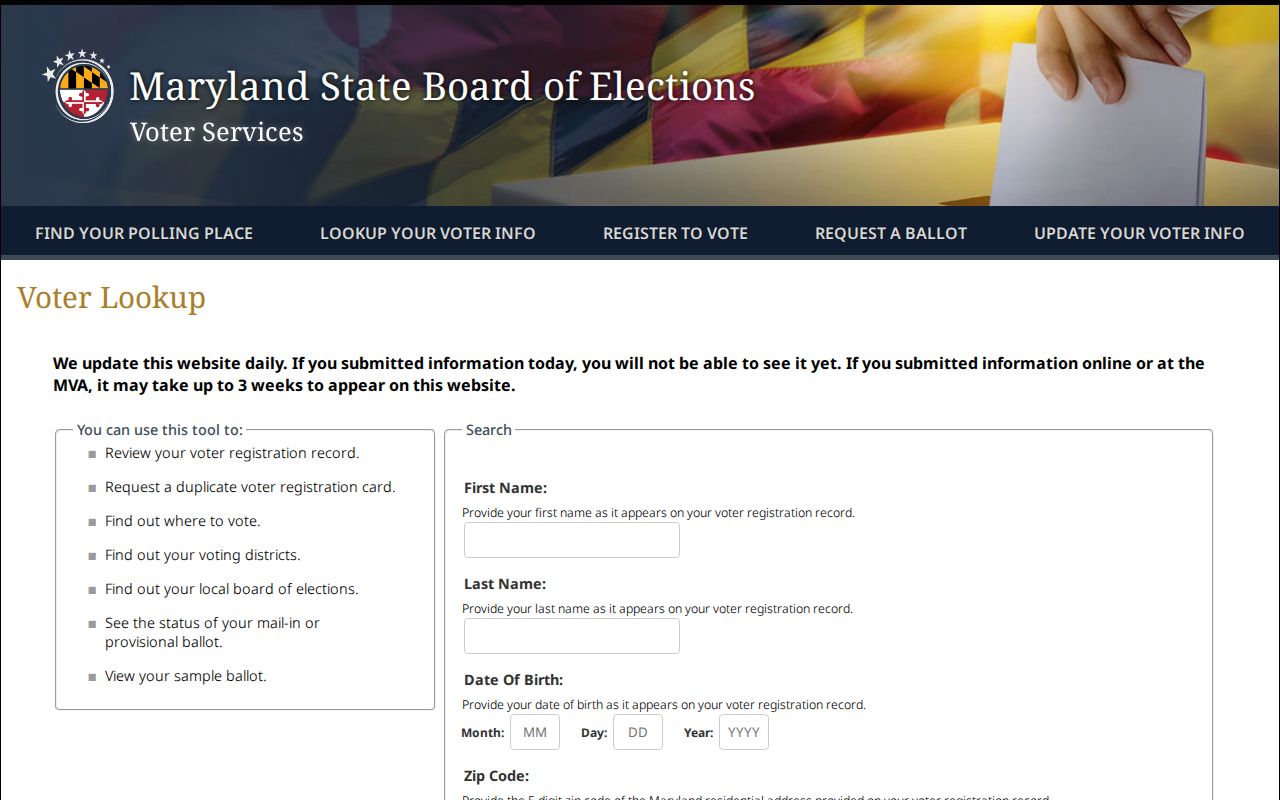
The form's required date of birth, ZIP, and street number draw a firm boundary around casual browsing. Voter-list access is separately limited to qualified electoral purposes. Protected voter information stays out of public hands.
Montgomery County Resident Vital Limits
Vital records are not one open name index. Recent Maryland births and deaths run through the Division of Vital Records. Marriage certificates date from 2007 forward. Divorce verifications also start at 2007. The decree comes from the granting Circuit Court. Birth records stay restricted for 100 years or until the named person's death, while recent deaths, direct-and-tangible-interest categories, and older Archives material follow their own access rules. Maryland's vital-record request guidance sorts the birth, death, marriage, and divorce routes, including mail, online, and in-person channels.
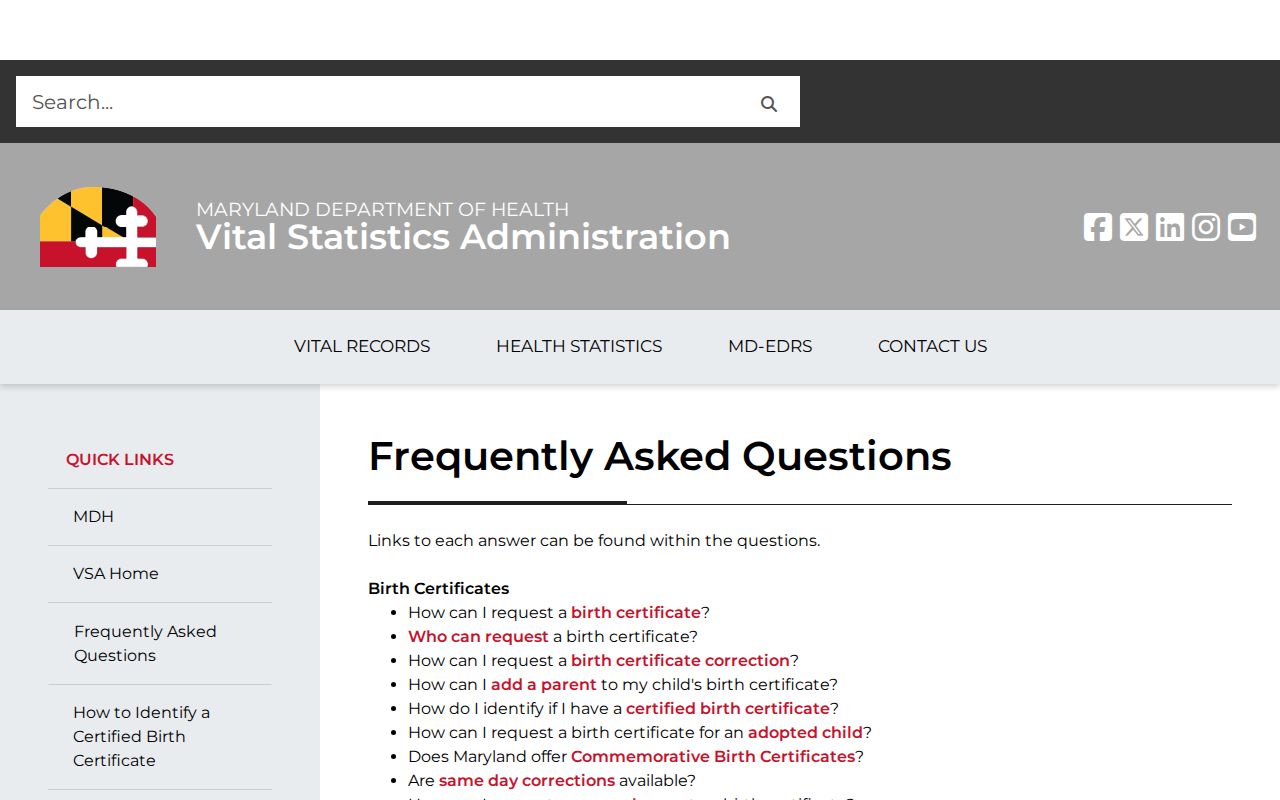
For local service, the Montgomery County Health Department handles appointment-based birth and death records in Silver Spring. An index can name a date or place. It never waives the certificate eligibility rule. For an older event, Maryland State Archives and Montgomery History abstracts are the documented fallback channels.
Montgomery County Estate and Affiliation Trails
Estate questions run on a different track than property searches. Case Search offers an estate mode. Enter a county or city. Or use a decedent or interested-party name, a date range, or an estate number. An entry may list a personal representative, heirs, proceeding type, and key dates. For anything deeper, the Montgomery County Register of Wills keeps permanent proceedings. It answers written or in-person requests at 50 Maryland Avenue, Room 322, Rockville.
Business and license records can support an affiliation check. They cannot settle whether someone actually lives in Montgomery County, though. Maryland Business Express shows entity status, a principal office, resident agent, trade-name filer, and amendment dates. It also lists filings. Maryland Labor's portal searches a last name or profession and returns public license status. A free result is only a starting point. Match it against a date, an address, or another official record. That confirms it before tying it to a particular resident.
Maryland PIA Request Route
The Maryland Public Information Act, General Provisions Article §§4-101–4-601, gives any person the right to request an existing government record. The custodian that holds the record is the one to ask. The law has limits. No office must create a list. It need not answer an abstract question, and it never has to assemble records it does not keep. A written application is the norm. A custodian can waive it, or simply make the record available for immediate inspection.
Timing rules matter. A custodian must grant or deny promptly and within 30 days at the outside. If production will exceed 10 working days, the office must send an estimate of the time, fees, and the reason for the delay. That notice is due inside the same 10-day window. The first two hours of search and preparation cost nothing. After that, reasonable copying and review charges may apply. Any denial must state its reason, legal authority, and appeal or dispute options. Route the request to the right custodian. Options include SDAT, the clerk, the elections office, DVR, Archives, or the office that created the record.
Montgomery County Lookup Terms
Record labels often look more conclusive than they really are. A searchable summary is not the same as the document a Montgomery County office holds. These terms help keep the two straight. They matter most when a name surfaces in a court index or a deed trail. The result still needs formal confirmation.
- Docket
- A court’s running record of case events. The online case summary can show events, but the complete file may include material not displayed online.
- Index
- A searchable list of record fields, such as a party name, case number, date, or deed reference. It points to a record and is not always the record itself.
- Image
- A viewable scan of the underlying document, such as a recorded deed. Availability online does not make every file or attachment available.
- Certified copy
- A copy issued by the custodian with its official certification. Montgomery Circuit Central Files charges the regular copy rate plus the certified-copy fee.
For Circuit Court material, the complete-file route is Central Files, North Tower Room 1100, 50 Maryland Avenue, Rockville. Staff strongly prefer a case number. Without one, they may still attempt a detailed party or date search. Open paper and electronic files can be inspected in person. Some older charges never shown online may remain available at the courthouse.
Montgomery County Records Do Not Prove Presence
A property card or ZIP result never proves that a person is physically present in Montgomery County. The same is true of a registry address. A recorded mailing address proves no more. The property roll names an assessed owner and a tax mailing address. A court index names a party to a case. Nothing more. Each source has one precise purpose, and each can be current, historical, incomplete, or protected. Those traits change what a search returns.
Treat any result as a lead, not a conclusion. The next appropriate record is the goal, not a verdict about a household. A deed confirms a recorded transfer. An estate record identifies an interested party. An eligible vital or archival source can establish a specific event. When two sources conflict, keep the dates and document references. Then ask the custodian about the record it maintains.
Privacy in Montgomery County Resident Lookup
Maryland records are open by category, not without limits. The PIA preserves exemptions built on statute, court rule, privilege, and other protections. DMV information, utility accounts, delivery records, and private account details never become public simply because they relate to a person or address. A parcel entry, ZIP result, or registry address likewise fails to prove physical presence.
Maryland Safe at Home gives eligible participants a substitute address with mail forwarding, and the actual address stays protected except under the program's lawful exceptions. The State Board of Elections offers a confidentiality form that can shield a residential address, phone, and email when disclosure would threaten someone or seriously invade privacy. Those protections can leave an expected voter result absent or thin. To fix an error, contact the custodian that actually holds the record, whether a property card, case, voter file, vital item, or permit.
Lawful use. These Montgomery County records support personal research, genealogy, estate matters, civic transparency, and safety verification. Never use a record to stalk, harass, intimidate, or harm another person.